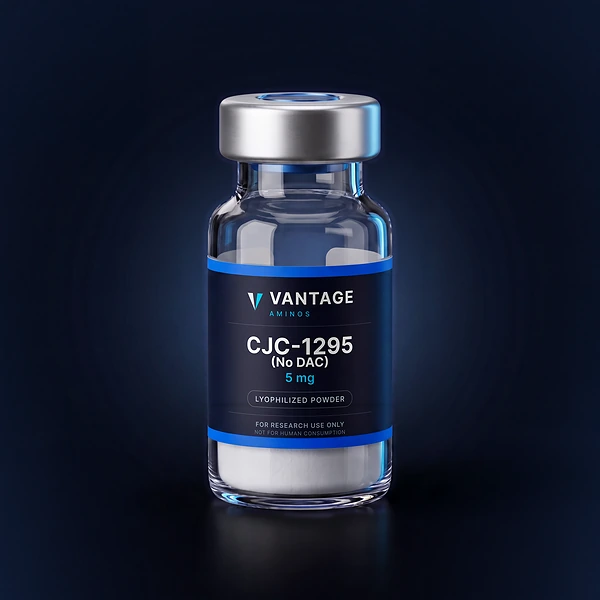
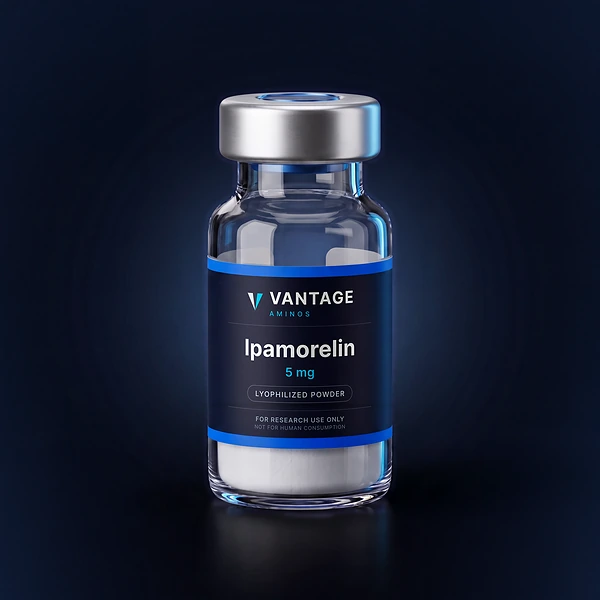
CJC-1295 No DAC and Ipamorelin are two distinct research peptides that both appear in growth-hormone-axis pharmacology literature and are frequently studied side by side. This page compares their verified chemical identity and the preclinical research models in which each appears. It does not compare human outcomes and does not recommend either compound for any use; both are supplied strictly as research materials.
In this comparison, “CJC-1295” refers to CJC-1295 No DAC (Modified GRF 1-29), the short-half-life variant without the Drug Affinity Complex (C152H252N44O42). The DAC-bearing variant is a chemically distinct compound (C165H269N47O46) and is not the subject of this comparison.
CJC-1295 No DAC, also called Modified GRF 1-29 (Mod GRF 1-29), is a synthetic analog of the first 29 amino acids of growth-hormone-releasing hormone (GHRH 1-29), with four amino-acid substitutions that improve stability. As a GHRH-receptor agonist, it is studied as a tool compound for pulsatile GH-secretion research. Without the Drug Affinity Complex (DAC), it does not bind circulating albumin, giving it a short half-life in research models.
Ipamorelin is a synthetic pentapeptide (sequence Aib-His-D-2-Nal-D-Phe-Lys-NH2) classified as a growth-hormone secretagogue (GHS) that acts as a selective agonist at the ghrelin / GH-secretagogue receptor (GHS-R1a). In preclinical research it is noted for a high selectivity profile in animal models.
The two are mechanistically complementary research tools: one is a GHRH-receptor analog, the other a ghrelin-receptor agonist. Both are supplied as lyophilized powders, water-soluble on reconstitution.
Side-by-side comparison (verified research properties)
| Property | CJC-1295 No DAC | Ipamorelin |
|---|---|---|
| Compound class | GHRH (1-29) analog (Modified GRF 1-29) | Pentapeptide GH secretagogue / ghrelin-receptor agonist |
| Receptor studied | GHRH receptor (GHRH-R) | Ghrelin / GHS receptor (GHS-R1a) |
| CAS number | 863288-34-0 | 170851-70-4 |
| PubChem CID | 56841945 (also 91976842) | 9831659 |
| Molecular formula | C152H252N44O42 | C38H49N9O5 |
| Molecular weight | ~3367.9 g/mol | 711.9 g/mol |
| Length | 29 residues, C-terminal amide | 5 residues (pentapeptide), C-terminal amide |
| Sequence | H-Tyr-D-Ala-Asp-Ala-Ile-Phe-Thr-Gln-Ser-Tyr-Arg-Lys-Val-Leu-Ala-Gln-Leu-Ser-Ala-Arg-Lys-Leu-Leu-Gln-Asp-Ile-Met-Ser-Arg-NH2 | Aib-His-D-2-Nal-D-Phe-Lys-NH2 |
| Primary research models | Pulsatile GH-secretion via GHRH-receptor signaling (animal models) | GHS-R1a agonism, GH-pulse studies, selectivity profiling (animal models) |
| Physical form | Lyophilized powder | Lyophilized powder |
Data verified against PubChem (CID 56841945 and 9831659), ChEMBL, and corroborating references.
How they differ in the research
The two compounds engage the GH axis through different receptors in the preclinical record:
- Receptor target. CJC-1295 No DAC is studied as a GHRH-receptor agonist (a GHRH 1-29 analog); Ipamorelin is studied as a ghrelin / GHS-receptor (GHS-R1a) agonist. They act on two separate pituitary signaling pathways.
- Size and class. CJC-1295 No DAC is a 29-residue GHRH analog (~3368 g/mol). Ipamorelin is a 5-residue pentapeptide (711.9 g/mol) containing non-standard residues (Aib = α-aminoisobutyric acid; D-2-Nal = D-2-naphthylalanine).
- Selectivity in research. Ipamorelin is noted in animal models for stimulating GH release with minimal effect on cortisol, prolactin, or ACTH, which makes it a useful tool for isolating GH-axis signaling. CJC-1295 No DAC is studied for producing short, discrete GH pulses via GHRH-receptor activation rather than sustained elevation.
- Why they are paired. Because the two act on complementary receptors (GHRH-R and GHS-R1a), they are commonly studied together in research examining combined GHRH-analog plus GH-secretagogue signaling, and are frequently offered as a combined research blend.
Comparisons here are between two research peptides, not to any FDA-approved drug. These mechanisms are described strictly in preclinical / animal research contexts and are not established human-use mechanisms. Neither compound is an FDA-approved drug.
QuestionsFrequently Asked Questions
What is the difference between CJC-1295 and Ipamorelin?
CJC-1295 No DAC is a 29-residue GHRH (1-29) analog (~3367.9 g/mol) studied as a GHRH-receptor agonist for pulsatile GH-secretion research. Ipamorelin is a 5-residue pentapeptide (711.9 g/mol) studied as a selective ghrelin-receptor (GHS-R1a) agonist. They act on different receptors and differ in size, class, and sequence.
Are CJC-1295 and Ipamorelin studied together?
Yes. Because they act on complementary receptors (GHRH-receptor and GHS-R1a), they are frequently studied side by side in GH-axis research and are commonly offered as a combined research blend. Any association is within research-model contexts only; neither is approved for human use.
Which receptor does each compound target in research?
CJC-1295 No DAC is studied as an agonist at the GHRH receptor; Ipamorelin is studied as an agonist at the ghrelin / GH-secretagogue receptor (GHS-R1a).
Is CJC-1295 a peptide like Ipamorelin?
Both are synthetic peptides, but they differ in length and class: CJC-1295 No DAC is a 29-residue GHRH analog, while Ipamorelin is a 5-residue pentapeptide containing non-standard residues (Aib, D-2-Nal).
Are CJC-1295 or Ipamorelin approved for human use?
No. Neither CJC-1295 No DAC nor Ipamorelin is an FDA-approved drug, and neither is intended for human consumption. Both are offered strictly as research compounds for laboratory use.
For research use only. Not for human or veterinary use. Not approved by the FDA. 21+
- HPLC + MS tested, on tested lots
- U.S. synthesized
- Batch COA on the pages that carry one