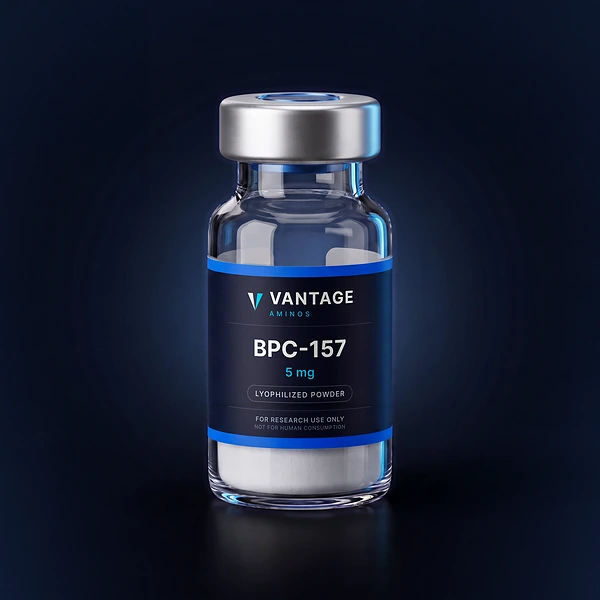
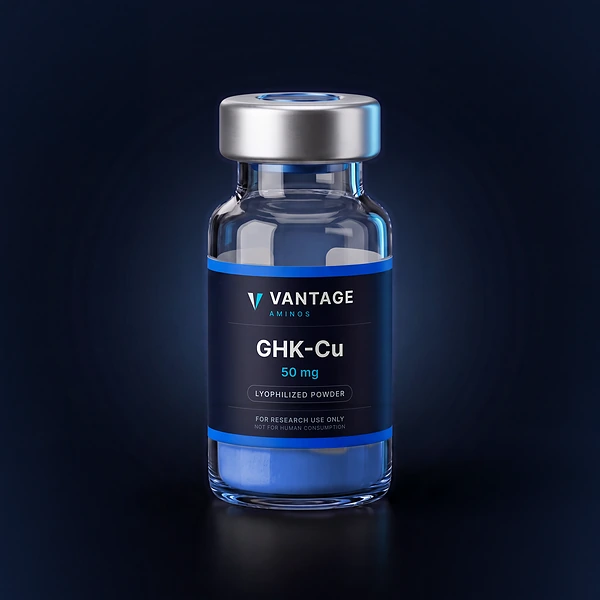
BPC-157 and GHK-Cu both appear across tissue-repair research, but one is a pentadecapeptide studied in angiogenesis and connective-tissue models and the other a copper tripeptide studied in dermal and extracellular-matrix models.
At a glance
| Property | BPC-157 | GHK-Cu |
|---|---|---|
| Class | Synthetic pentadecapeptide | Copper tripeptide (Gly-His-Lys-Cu) |
| Primary research target | NO / VEGF / angiogenic signaling | Copper transport / ECM remodeling |
| Research domain | Tissue-repair (tendon, GI) | Dermal / extracellular matrix |
| Structure | 15-residue peptide | Tripeptide-copper complex |
| Format | Lyophilized powder | Lyophilized powder |
BPC-157 in research
BPC-157 is a synthetic pentadecapeptide studied in angiogenesis, nitric-oxide-pathway, and connective-tissue research models. See the full BPC-157 research profile.
GHK-Cu in research
GHK-Cu is a naturally occurring copper-binding tripeptide studied in dermal, collagen, and extracellular-matrix remodeling research models. See the full GHK-Cu research profile.
Key differences
- BPC-157 research centers on angiogenic and connective-tissue pathways; GHK-Cu on copper-transport and ECM remodeling.
- BPC-157 is studied in tendon and gastrointestinal models; GHK-Cu in dermal and matrix models.
- Both are supplied as lyophilized research peptides.
Selecting for a research model
Researchers select between BPC-157 and GHK-Cu based on whether a systemic tissue-repair peptide or a copper-tripeptide dermal/ECM mechanism fits the model. These distinctions are described strictly in the context of research models and are not statements of efficacy, safety, or suitability for any use.
Both BPC-157 and GHK-Cu ship from Vantage Aminos with a batch-specific Certificate of Analysis (HPLC purity and mass-spectrometry identity), U.S. synthesized for research use.
For research use only. Not for human or veterinary use.
- HPLC + MS tested, on tested lots
- U.S. synthesized
- Batch COA on the pages that carry one