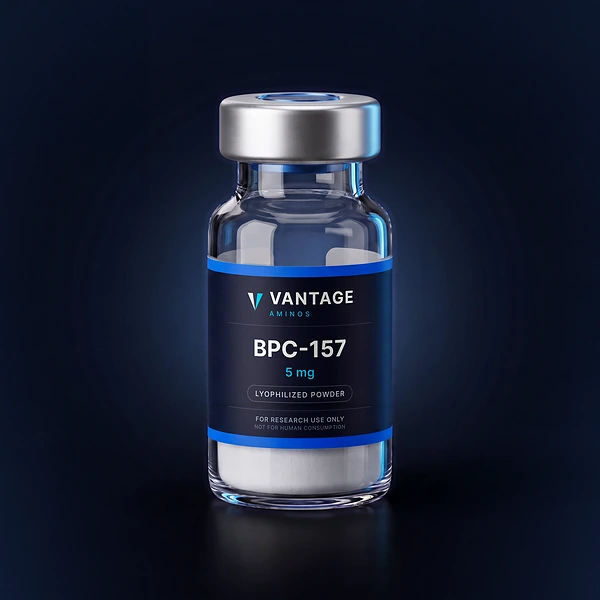
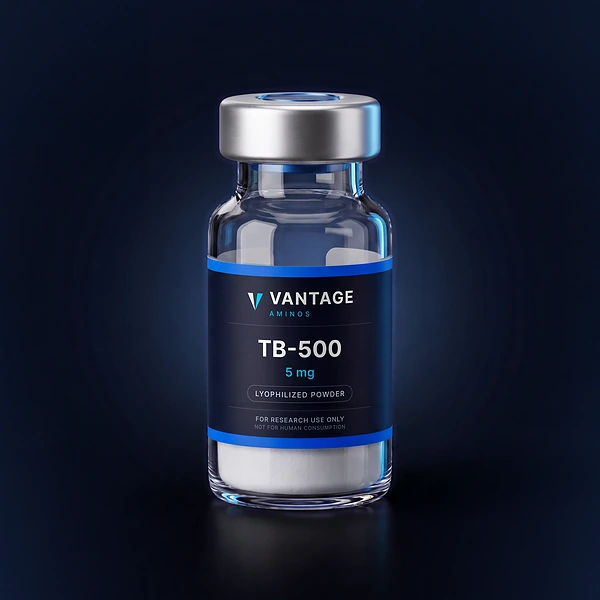
BPC-157 and TB-500 are two distinct research peptides that are frequently studied (and frequently searched) alongside one another. This page compares their verified chemical identity and the preclinical research models in which each appears. It does not compare human outcomes and does not recommend either compound for any use; both are supplied strictly as research materials.
BPC-157 is a synthetic pentadecapeptide, a chain of 15 amino acids (sequence GEPPPGKPADDAGLV) corresponding to a partial sequence identified within human gastric juice. In preclinical literature it is studied as a stable peptide construct in models of angiogenesis, nitric-oxide-pathway signaling, and connective-tissue biology. The “BPC” designation derives from “Body Protection Compound,” the name used in the early gastric-peptide literature.
TB-500 is full-length thymosin beta-4 (Tβ4), a synthetic 43-residue peptide identical in sequence to a naturally occurring protein found broadly across mammalian tissues. It is one of the most-studied actin-sequestering peptides in preclinical literature, used as a tool compound to investigate cytoskeletal dynamics, cell migration, and tissue-remodeling signaling in research models. (Note: Vantage’s TB-500 is the full 43-residue protein, not the short Ac-LKKTETQ fragment some vendors sell under the same name.)
Both are supplied as lyophilized powders that are water-soluble on reconstitution.
Side-by-side comparison (verified research properties)
| Property | BPC-157 | TB-500 (Thymosin beta-4) |
|---|---|---|
| Compound class | Synthetic pentadecapeptide | Full-length thymosin beta-4 (Tβ4) |
| CAS number | 137525-51-0 | 77591-33-4 |
| PubChem CID | 9941957 | 45382195 |
| Molecular formula | C62H98N16O22 | C212H350N56O78S |
| Molecular weight | ~1419.5 g/mol | ~4963 g/mol |
| Length | 15 residues (pentadecapeptide) | 43 residues |
| Sequence | GEPPPGKPADDAGLV | SDKPDMAEIEKFDKSKLKKTETQEKNPLPSKETIEQEKQAGES |
| Naturally occurring? | Partial sequence from gastric juice; not a discrete human protein | Identical to a naturally occurring mammalian protein |
| Primary research models | Angiogenesis, nitric-oxide pathway, connective-tissue / GI tissue models | Actin sequestration, cell migration, tissue-remodeling models |
| Physical form | Lyophilized powder | Lyophilized powder |
Data verified against PubChem (CID 9941957 and 45382195) and corroborating references.
How they differ in the research
The two compounds are studied through different mechanistic lenses in the preclinical record:
- Size and structure. BPC-157 is a short 15-residue synthetic peptide (~1419 g/mol); TB-500 is a much larger 43-residue full-length protein (~4963 g/mol). They share no sequence homology.
- Research-model emphasis. BPC-157 is most often examined in angiogenesis, nitric-oxide-pathway, and connective-tissue research models. Thymosin beta-4 (TB-500) is most often examined for its actin-sequestering behavior (the binding of G-actin monomers that influences cytoskeletal assembly) and in cell-migration and matrix-remodeling models.
- Biological origin. BPC-157 derives from a partial sequence identified in gastric juice and does not occur as a discrete protein in the human proteome. Thymosin beta-4 is a naturally occurring intracellular protein present across many mammalian cell types.
- Overlap. Both appear in angiogenesis-related tissue-model literature, which is one reason researchers reference them together. Any overlap is in the research models studied, not in established human effects. There are no large controlled human trials establishing either compound for a therapeutic use, and neither is an FDA-approved drug.
These mechanisms are described strictly in in vitro and animal research contexts; they are not established human-use mechanisms.
QuestionsFrequently Asked Questions
What is the difference between BPC-157 and TB-500?
BPC-157 is a synthetic 15-amino-acid peptide (GEPPPGKPADDAGLV, ~1419.5 g/mol) studied in angiogenesis and connective-tissue research models. TB-500 is full-length thymosin beta-4, a 43-residue peptide (~4963 g/mol) studied for actin sequestration and cell-migration signaling. They differ in size, sequence, and the research models each appears in, and share no sequence homology.
Are BPC-157 and TB-500 studied together?
They are frequently referenced together in the preclinical literature, particularly in angiogenesis-related tissue models, and are commonly offered as a combined research blend. Any association is within research-model contexts only; there are no controlled human trials establishing combined use, and neither is approved for human use.
Which has the larger molecule, BPC-157 or TB-500?
TB-500 (thymosin beta-4) is substantially larger: a 43-residue peptide at ~4963 g/mol versus BPC-157’s 15-residue ~1419.5 g/mol structure.
Is BPC-157 the same class of compound as TB-500?
No. BPC-157 is a short synthetic pentadecapeptide derived from a gastric-juice sequence; TB-500 is full-length thymosin beta-4, a naturally occurring 43-residue protein. They are chemically and structurally distinct.
Are BPC-157 or TB-500 approved for human use?
No. Neither BPC-157 nor TB-500 is an FDA-approved drug, and neither is intended for human consumption. Both are offered strictly as research compounds for laboratory use.
For research use only. Not for human or veterinary use. Not approved by the FDA. 21+
- HPLC + MS tested, on tested lots
- U.S. synthesized
- Batch COA on the pages that carry one